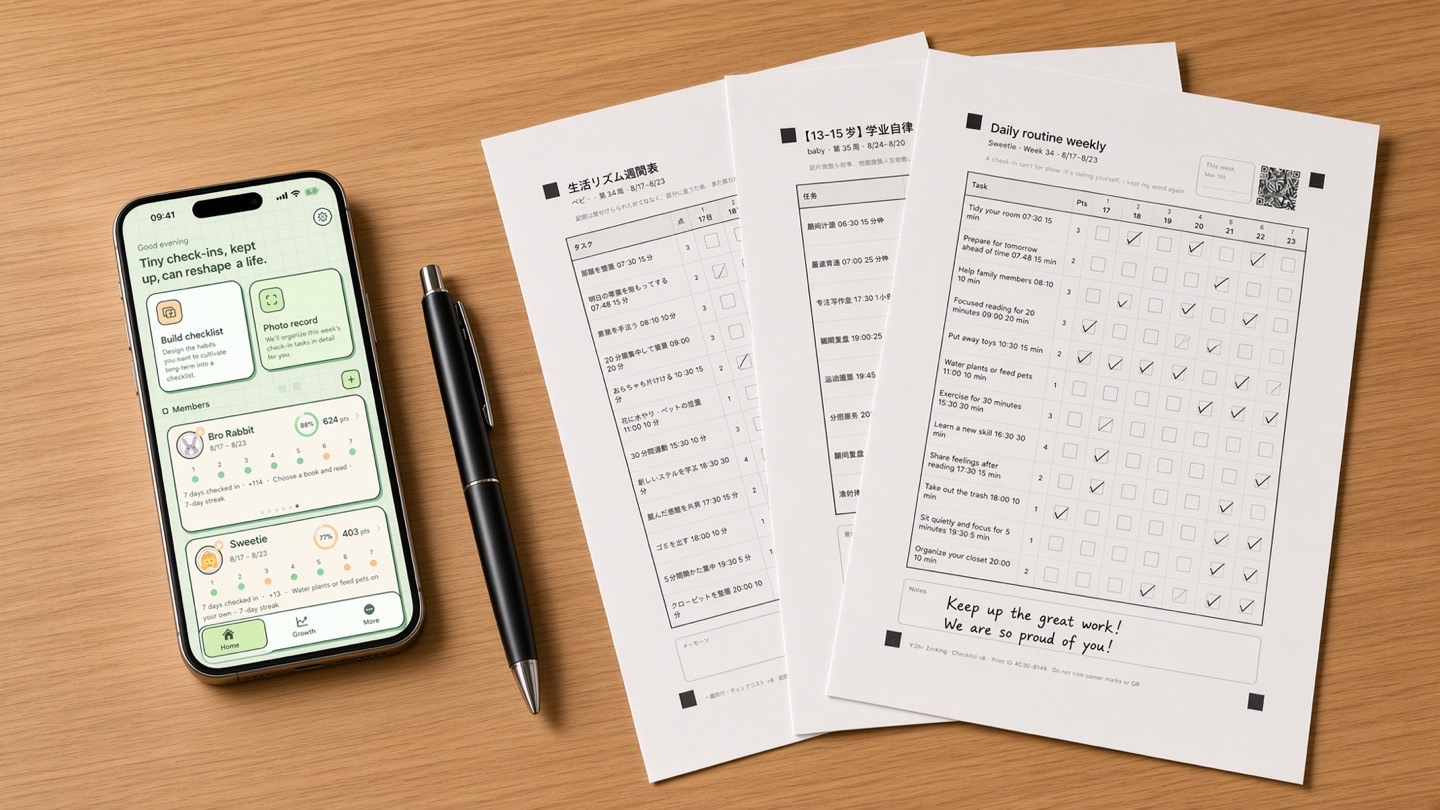
What a sheet of paper can prove — and what it can’t
Plenty of habit apps will tell you that 21 days makes a habit. We won’t, because it doesn’t hold up. This page sets out what we actually believe and what every sentence of feedback in the app rests on.
Sunday eveningA week later, every tick is still on the pageScan at the weekend and the week’s ticks become points and a growth curve.
01
Repetition matters more than an unbroken streak
What makes a behaviour easier is doing it again and again in a similar situation, not going a whole month without a miss. So the sheet counts by the week, and an empty box resets nothing — miss a day and next week still starts calmly.
02
There’s a reason it goes on the fridge
Behaviour attaches to a fixed place and a fixed moment far better than to a sudden thought. A sheet that always hangs in the same spot is that cue: walk past, see it, get it done. A phone notification can’t do that job — notifications get swiped away.
03
66 days is somebody else’s average
The number comes from Lally et al. (2010): in that sample, the modelled average time to reach about 95% of a personal automaticity plateau was 66 days, while individual estimates ranged from 18 to 254 days. It describes the spread of a group, not a deadline for your child. The app does mention day 66 — and says plainly that it is not a finish line.
04
A blank box is not a failure
Once a streak breaks, people tend to abandon the whole thing — research calls it going off track. So we don’t count streaks and never show “you ruined 37 days”. After a gap the app says something else: planning the next step beats blaming yourself.
05
Too many tasks? Make them smaller
A sheet with a dozen lines looks ambitious and tends to end the week empty. When too many tasks run at once, the app suggests keeping a smaller version that’s easy to start: five minutes of reading instead of twenty still beats a blank box.
06
We record what was done. We don’t measure automaticity
A scan knows exactly one thing: a given box on a given day was filled. That shows the behaviour was repeated and recorded. It is no substitute for an automaticity scale and cannot establish that a habit has formed. The stage names in the app — starting, building, consolidating — describe the shape of the record, and the growth calendar carries the same caveat. We would rather understate it.
What we read
The same list sits in the app’s habit-science screen, each entry linking to the source. We won’t summarize them for you — we just show where the ideas come from.
Check by Check is a family record-keeping tool, not a medical or mental-health product. It offers no diagnosis, treatment or professional advice. If you are worried about a child’s attention, mood or development, please talk to a professional.
Stick a sheet on the wall tonight. Start off-screen tomorrow.
Habits happen on paper; the phone helps only now and then. Free on iPhone and iPad, no account required.